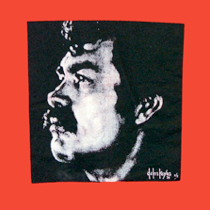
Rodolfo “Corky” Gonzales
1928 - 2005
“I shed tears of anguish
As I see my children disappear
Behind the shroud of mediocrity
Never to look back to remember me.
I am Joaquin. I must fight
And win this struggle for my sons,
And they must know from me
Who I am.”
-- from “I Am Joaquin”
by Rodolfo “ Corky” Gonzales
And so - Rodolfo
Gonzales, a political activist destined to take the lead, set the
example, and inspire many people, chose his fight: “The Crusade For
Justice”. Rodolfo “Corky” Gonzales was born in Denver on June 18, 1928
to Federico and Indalesia Gonzales. He was the youngest of five brothers
and three sisters, Nattie, Beatrice, Tomas, Esperanza, Federico,
Severino, and Arturo. Corky's mother died when he was two years old and
his father never re-married, but managed somehow to keep the Gonzales
family together. The senior Gonzales ruled his household with a firm
hand, tempered with love.
The children grew up in the
tough eastside barrio of Denver during the devastating Depression.
Rodolfo said, "Though the Depression was devastating to so many, we, as
children, were so poor that it (the Depression) was hardly noticed."
Corky's father had
emigrated from Mexico to Colorado early in life and often spoke to Corky
about the Mexican Revolution, Mexico’s history, and the pride of the
Mexican people. Thus leaving little doubt in Corky's mind about his own
identity - and possibly his destiny.
With the tremendous
obstacles that faced Rodolfo from an early age, it is truly astonishing
that he persevered in the Denver educational system to earn his high
school Diploma at the age of 16. The accomplishment is magnified by the
fact that from an early age, Rodolfo worked in the beet fields and at
various other jobs that left little time for study. Corky attended many
schools including schools in New Mexico as well as schools in Denver,
Gilpin, Whittier, Lake, Baker, West, and finally Manual High School from
which he graduated in 1944.
During his final year in
high school and the subsequent summer, Corky worked hard to save money
for a college education. With a keen interest in engineering, Corky
entered the University of Denver, but after the first quarter realized
that the financial cost was insurmountable. Rodolfo then pursued a
career in Boxing. An outstanding amateur national champion Rodolfo
became one of the best featherweight (125 lb) fighters in the world.
Even though Ring Magazine ranked Corky number three in the world, he
never got a justly deserved title shot.
In the mid-1960's, Rodolfo
Gonzales founded an urban civil rights and cultural movement called the
Crusade for Justice. Soon he became one of the central leaders in the
Chicano movement and a strong proponent of Chicano nationalism. In the
late sixties and early seventies, Corky Gonzales organized and supported
high school walkouts, demonstrations against police brutality, and
legal cases. He also organized mass demonstrations against the Vietnam
War.
In 1968 Gonzales led a
Chicano contingent in the Poor People's March on Washington, D.C. While
there, he issued his "Plan of the Barrio" which called for better
housing, education, barrio-owned businesses, and restitution of pueblo
lands. He also proposed forming a Congress of Aztlan to achieve these
goals.
One of the most important
roles played by Gonzales was as an organizer of the Annual Chicano Youth
Liberation Conference, an ambitious effort to create greater unity
among Chicano youth. These Conferences brought together large numbers of
Chicano youth from throughout the United States and provided them with
opportunities to express their views on self-determination. The first
conference in March 1969 produced a document, “EL PLAN ESPIRITUAL DE
AZTLAN (THE SPIRITUAL PLAN OF AZTLAN)”, which developed the concept of
ethnic nationalism and self-determination in the struggle for Chicano
liberation. The second Chicano Youth Conference in 1970 represented a
further refinement in Corky Gonzales's efforts toward Chicano
self-determination, the formation of the Colorado Raza Unida Party.
During this time Corky and
his wife, Geraldine Romero Gonzales, raised a family of six daughters
and two sons, Nita, mother of two children; Charlotte, mother of three;
Gina, mother of three; Gail, mother of four; Rudy, father of one;
Joaquin, father of three; Cindy, mother of two; and Valerie, mother of
two. All their children remain in Denver and continue to carry on
Corky's fight with his guidance. Corky is proud of his family,
especially the twenty-four grandchildren and seven great-grandchildren.
Recently celebrating his fifty-sixth wedding anniversary, Corky
attributed the closeness and strength of his family to his beloved wife,
Geraldine, who has been his most enthusiastic and ardent supporter.
In many ways, Corky
Gonzales has greatly influenced the Chicano movement. His key to
liberation for the Chicano community is to develop a strong power base
with heavy reliance on nationalism among Chicanos. His contributions as a
community organizer, youth leader, political activist, and civil rights
advocate have helped to create a new spirit of Chicano unity.
Rodolfo "Corky” Gonzales'
life has been a collage of challenges that have been met and overcome.
He has never wavered in his commitment to enhance the lives of his
people in this country, to change what is not fair, what is not right.
As long as there are injustices, double standards, racism, and apathy,
Corky's dedication, loyalty, and love of the struggle against these
diseases of society will serve as an inspiration for all people to act.
In his column in the Denver Post of January 6, 1988, Tom Gavin wrote,
"He’s grizzled now, and gray,
but he stands tall, Corky Gonzales does,
and taller still, Rodolfo "I am Joaquin" Gonzales.
The one was a pretty good boxer, the other is a leader of men."